
At a glance
The in-house versus agency debate is usually framed as a binary choice. It is not. Most brands that are genuinely succeeding at marketing have stopped treating it that way. The more useful question is not “which is better?” but “what does my brand need right now, and which structure is best equipped to deliver it?” This guide gives you an honest account of what in-house teams do genuinely well, what digital marketing agencies do genuinely well, and how to figure out which structure, or combination, fits where you are today.
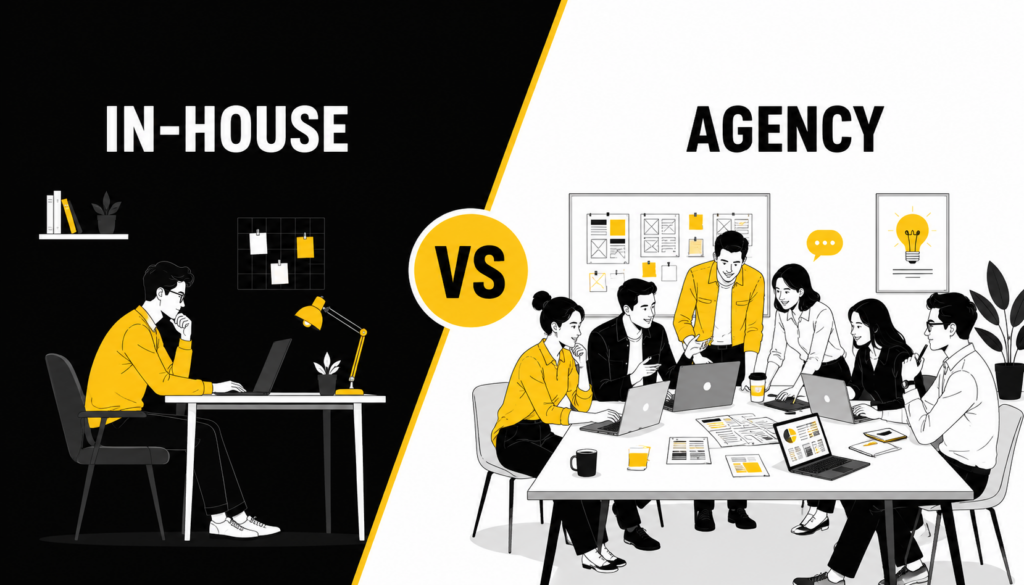
Every creative agency will tell you that in-house teams lack specialist capability and cross-industry perspective. Every brand that has built an in-house team will tell you that agencies lack accountability, brand intimacy, and institutional memory. Both sides are partially right. And both sides are missing the point.
In Singapore’s marketing landscape, the stakes of getting this wrong are real in both directions. Hire in-house too early or too broadly, and you are carrying permanent headcount and fixed overhead for capability you cannot fully utilise. Stay with a digital marketing agency too long without the right internal structure, and you end up paying for activity rather than outcomes, with no one inside the business who truly owns the brand.
The answer, as with most structural decisions, starts with being honest about what each model is genuinely good at, and where each one quietly fails.
What In-House Teams Do Better Than Agencies

The case for in-house marketing is stronger than agencies typically acknowledge. There are real, structural advantages to having marketing capability sitting inside the business. But those advantages come with conditions that most brands underestimate.
Brand knowledge that compounds over time
An in-house marketer who has been with a brand for two or three years holds institutional knowledge that no agency account manager can replicate. They understand the internal dynamics around certain messages. They know what leadership will and will not approve. They have context that takes years to build, and that context genuinely improves the quality of marketing decisions.
Speed of execution on reactive work
In-house execution can be significantly faster for certain types of work, particularly anything that requires real-time response. Community management, customer support, and sales-adjacent conversations should, in most cases, be handled internally. The fewer parties a customer interaction passes through, the better the experience. For brands where marketing is tightly tied to revenue, such as e-commerce businesses running primarily on digital channels to drive both top and bottom line, an in-house team will always know the product better than an external partner on those day-to-day touchpoints.
Alignment with business context
In-house teams sit alongside the sales team, the product team, and leadership. Strategic conversations happen organically. There is no briefing lag, no translation layer between business reality and marketing execution. That proximity, when it is genuine, has real value.
Cost predictability at scale
Beyond a certain volume of output, in-house production becomes cheaper per unit than agency fees. If output volume is consistently high and predictable, and the strategy is already set, building some internal execution capability starts to make financial sense.
Where In-House Teams Quietly Struggle
Here is what does not get said enough: in-house marketing teams are frequently set up to fail.
The expectation placed on an internal marketing team, often a small group, sometimes a single hire, is routinely impossible. Brands expect one or two people to own strategy, execute campaigns, manage community, handle performance marketing, produce creative, and report on analytics, all simultaneously, across every channel and format. That is not a marketing team. That is an unrealistic job description spread across too few people.
Having spent time on both sides of this, the pattern is consistent. In-house marketers can and should be the gatekeepers of brand. They should hold the strategy, manage agency relationships, and ensure everything that goes out is aligned with the business. But expecting them to execute everything on top of that is where brands consistently go wrong. It is simply an impossible task that too many businesses place on their “marketing” team, and it rarely ends well for the marketer or the brand.
There is also a structural question worth considering about remote in-house setups. If your internal marketing team is working remotely, largely independent of the broader business, and producing work in isolation, it is worth asking what you have actually gained over working with an experienced external partner. The proximity advantage that makes in-house valuable disappears when the team is not genuinely embedded in the business.
What a Digital Creative Agency Does Better

The case for working with a digital creative agency is also stronger than internal teams typically acknowledge.
Breadth of specialist capability
A full-service digital marketing agency gives you simultaneous access to a strategist, creative director, art director, copywriter, social media manager, SEO specialist, media buyer, analytics lead, and production team, on a single retainer. Assembling that equivalent in-house, at the level of seniority and specialisation that actually moves the needle, would cost multiples more in headcount alone. And unlike a permanent hire, agency capacity can scale with your needs.
Cross-industry perspective
A digital creative agency working across ten or fifteen brands in a given year builds pattern recognition that no single-brand in-house team can develop. They have seen what works in your competitor’s category. They know which creative formats are driving results on TikTok for F&B brands, what is converting in e-commerce right now, and where the market is heading before it becomes obvious. That cross-pollination of insight is structurally unavailable to an in-house team, no matter how talented they are.
Objectivity
An in-house team exists inside the brand’s culture. Over time, that closeness can become a limitation. Ideas get self-censored. Assumptions go unchallenged. Creative gets safe.
A good digital marketing agency is paid to produce effective work and evaluated on whether it does. That creates a structural incentive to push back on briefs, challenge assumptions, and propose directions that an internal team might not. The best agency relationships are the ones where that tension is productive — where the agency brings outside perspective and the client brings inside knowledge, and the work is better for both.
Scalability without the overhead
This is the practical reality most brands eventually arrive at. When you hire in-house, you are making a permanent commitment. You cannot hire one person and expect them to cover everything. You cannot scale down quickly when a campaign ends or add a specialist skill for a short-term project without another permanent headcount decision. A digital creative agency gives you that scalability without those constraints. It is also what allows clients to stay focused on their business and their brand, while the agency focuses on elevating results. For most brands, that division of focus has compounding value.
The Decision Framework: Which Structure Fits Your Brand Right Now?
| Dimension | In-House | Agency | Hybrid |
| How much are you producing? | High and consistent, same formats, same cadence | Variable, campaign bursts with quieter periods in between | Both, high volume day-to-day plus periodic campaign work |
| Where is your brand right now? | Established with a clear, settled identity | New, entering a new market, or going through a rebrand | Building the brand while activating performance channels simultaneously |
| What is your budget? | Above S$20,000/month with sustained headcount budget | Below S$20,000/month all-in | S$20,000 to S$80,000/month with a mix of execution and strategic needs |
| How fast do you need to move? | Daily reactive content and real-time community management | Quarterly campaign cycles and longer strategic planning horizons | A mix of planned campaign work and reactive day-to-day |
| Do you already have the skills you need? | Yes, core disciplines are covered internally | No, multiple specialist disciplines are missing | Some functions covered internally, gaps filled by specialist agency support |
Why Most Singapore Brands End Up With a Hybrid and How to Make It Work?
The hybrid model has become the default for most brands beyond a certain scale, not because it is theoretically optimal, but because no single structure covers every need.
The brands that make it work share a few consistent habits. The in-house team owns brand guardianship, community management, and reactive content. The digital marketing agency owns strategic and campaign creative. Those lanes are clear, and they do not overlap. The in-house lead manages the agency relationship and holds the brand strategy, even if the agency helped develop it. Agencies are briefed as strategic partners, not production vendors: with business objectives, audience insight, and clear success metrics, not just execution requirements and a mood board.
The quality of agency vs in-house output often comes down to one thing: the brief. A focused in-house marketer, freed from trying to execute everything themselves, is well-placed to brief an agency properly. And the results follow.
How to Know Which Structure You Actually Need
Start with one question: what is the specific marketing challenge your brand needs to solve in the next 12 months?
If it is building brand awareness in a new market, a good digital creative agency will outperform a small in-house team. If it is managing a high-volume content operation for an established brand where strategy is set and execution is the bottleneck, some in-house capability starts to make sense. If it is both building the brand and driving performance simultaneously, the hybrid model, structured well, is the only setup that covers all of it.
The wrong choice is rarely fatal. But the right choice, made deliberately, compounds over time. A brand that has the right structure for its stage grows faster and wastes less, not because the people are different, but because the model lets them focus on what they are actually good at.
At LOKi, we work with brands at every stage of that decision, whether you are building a digital marketing agency relationship from scratch, restructuring a hybrid model that is not working, or simply figuring out where to start. Talk to us and we can work through it together.

Frequently Asked Questions
Is building an in-house marketing team in Singapore worth it?
It depends on what you need them to do. In-house makes sense when you need speed on reactive work, deep brand knowledge in customer-facing roles, or a senior internal lead to manage agency relationships. It rarely makes sense as a full replacement for the breadth of capability a digital marketing agency provides.
At what point should a Singapore brand consider hiring in-house rather than using an agency?
When volume and predictability are high enough that cost per output tips in favour of headcount, or when you need someone embedded in the business to manage an increasingly complex agency relationship. In most cases, the first in-house hire should be a brand or marketing manager — someone who owns strategy and manages partners, not someone expected to execute everything alone.
What are the biggest hidden costs of building an in-house marketing team in Singapore?
Permanent headcount is the most obvious. But the less visible cost is scope creep — the expectation that a small internal team will cover strategy, execution, community, performance, and creative simultaneously. That expectation leads to burnout, high turnover, and mediocre output across the board.
What should an in-house team always own, even when working with an agency?
Brand strategy, agency briefing, community management, and customer-facing communications. These are the areas where internal knowledge is a genuine advantage and where losing the thread to an external party creates real risk.
How should we evaluate whether our current agency is actually delivering value?
Start with outputs versus outcomes. Is the agency producing work, or producing results? Are they bringing strategic thinking to briefs, or just executing them? Are they proactively flagging what is not working? A good digital creative agency should make your marketing better, not just busier.
Does LOKi work as part of a hybrid in-house and agency model?
Yes. Many of our clients have internal marketing leads who manage the relationship on their side. We work well in that structure — as a strategic and creative partner, not a production vendor. If you are figuring out how to structure that, we are happy to work through it with you.